BIG NEWS: Homestead is a 2026 BBB Torch Awards for Ethics Finalist.
READ THE STORY →


An effective HOA board meeting should produce decisions, clear direction, and defined follow-through—not merely discussion. The strongest meetings use a prepared agenda, keep as much business in open session as appropriate, give homeowners a structured opportunity to be heard, and keep directors focused on governing rather than performing. When an item is ready, decide it. When it is not, identify exactly what is missing, who will get it, and when the matter comes back.
Most meeting advice focuses on parliamentary procedure. Homestead can say something more useful: the purpose of a board meeting is to move the community forward. Management should arrive prepared. Directors should govern rather than perform. Homeowners should be heard without becoming the governing body. Decisions should be made when the information is ready. And every item should leave the meeting with an outcome.
An effective HOA board meeting should produce decisions, clear direction, and defined follow-through—not merely discussion. The strongest meetings use a prepared agenda, keep as much business in open session as appropriate, give homeowners a structured opportunity to be heard, and keep directors focused on governing rather than performing. When an item is ready, decide it. When it is not, identify exactly what is missing, who will get it, and when the matter comes back.
There is a strange way HOA meetings can become unproductive while still looking productive. Everybody talks, questions get asked, and opinions get offered. History gets revisited and somebody suggests doing more research. Another person raises a related concern. Before you know it forty-five minutes disappear. And then the board moves to the next item without actually deciding anything. That is not caution. That is often decision avoidance.
Boards exist to govern and governing requires choices. Approve it, decline it, or change it. Direct management to obtain one specific missing piece of information. Send it to the appropriate professional. Choose between the available alternatives. But move the issue somewhere.
Not every issue should be decided immediately. Sometimes an engineer needs to answer a question; legal counsel needs to review something; a proposal is incomplete; a material cost is unknown; or the governing documents need to be checked. That is responsible governance. But there is an important difference between a deliberate pause and indefinite deferral.
A deliberate pause sounds like: “Management will obtain the missing drainage opinion and return this item for decision at the October meeting.”
Decision avoidance sounds like: “We probably need to think about this some more.”
One has an owner, a deliverable, and a return date. The other simply postpones responsibility. An imperfect decision made from adequate information can usually be corrected, adjusted, monitored, or improved. A community that refuses to decide can sit still while contracts expire, maintenance worsens, projects inflate in cost, homeowner frustration grows, and the same subject consumes meeting after meeting. Doing nothing has consequences too.
Trust disappears quickly when homeowners believe important association business is happening somewhere they cannot see. That does not mean every conversation belongs in public. Legal advice, certain personnel matters, individual privacy issues, litigation, owner discipline, and other protected matters may appropriately belong in executive or closed session depending on the jurisdiction and circumstances. But executive session should not become the comfortable place a board retreats whenever a subject is controversial.
Openness should be the operating instinct. Privacy should have a reason.
That distinction matters culturally as much as legally. A difficult landscaping decision can usually happen in public. A disagreement among directors can happen in public. A vendor recommendation can usually happen in public. A budget tradeoff can happen in public. Homeowners seeing directors ask questions, disagree respectfully, hear competing viewpoints, and ultimately vote is not evidence that the association is dysfunctional. It is often evidence that governance is actually occurring.
Colorado law generally requires board meetings to be open to owners and gives owners an opportunity to speak regarding an issue before the board votes; reasonable time restrictions are permitted. Colorado also limits executive-session subjects to specified categories and prohibits adopting a rule or regulation while in executive session. Colorado General Assembly
Arizona's statutes for both planned communities and condominiums likewise establish open-meeting requirements. They expressly provide an opportunity for members to speak after board discussion of a specific agenda item and before formal action, subject to reasonable time restrictions. Arizona also limits the subjects that may be handled in a closed portion of a meeting and declares a state policy favoring open meetings. Arizona Legislature
The association's governing documents and the circumstances still matter. When there is uncertainty over whether a discussion belongs in executive session or what action may be taken, involve association counsel.
This is one of the great meeting-management skills.
Homeowners need an opportunity to be heard. They do not need to become an unelected sixth, seventh, or fifteenth member of the board. Those are different things. A functional board can create meaningful homeowner participation while still preserving the board's responsibility to govern. In fact, there is an irony here: The more consistently people know they will be heard, the less often they feel compelled to force themselves into the conversation.
When owners believe the only way to get anyone's attention is to interrupt, interruptions become predictable. When there is a reliable process—management explains the item, directors discuss it, owners have a defined opportunity to comment, and then the board decides—the pressure changes.
Being heard also does not mean winning. A homeowner can explain why they oppose a project. The board can genuinely listen, ask a clarifying question, thank them for the input, and still vote to approve it. That is not ignoring the homeowner. That is governance.
For a decision item, the flow can often be this simple:
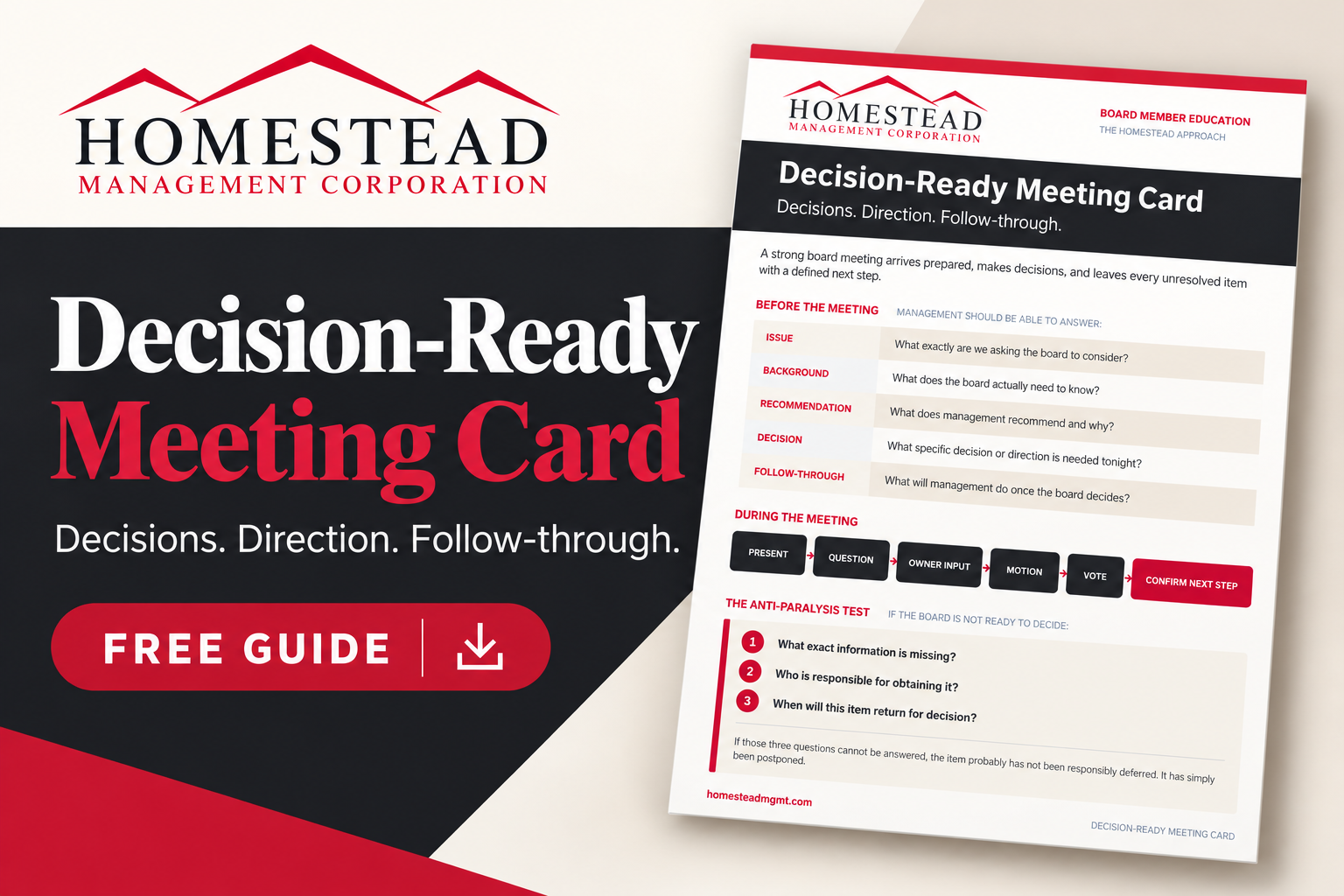
Management presents the issue → management gives its recommendation → directors ask questions and discuss → homeowners receive the appropriate opportunity to comment → the board makes a motion and votes → management confirms the next step.
Notice what is not in that sequence: A forty-minute free-form debate among everyone in the room.
A professionally managed community should not arrive at its board meeting and ask: “So... what does everybody want to talk about tonight?”
The agenda is the meeting map.
During the month, directors should send matters they believe need board consideration to their Community Manager. Management can determine what information is needed, gather background, obtain proposals or professional input, identify the decision required, and organize the agenda accordingly. By meeting night, the board should be looking at prepared business—not discovering business. That does require trust. A board needs confidence that its manager knows the community well enough to understand:
The board retains its governing authority. An agenda can change when circumstances require it. But constantly abandoning the prepared agenda because somebody remembered a pet issue at 8:17 p.m. is not flexibility. It is how meetings become three hours long.
Every board has people with experience, which is valuable. An engineer may recognize a construction issue. An accountant may notice something important in the financials. An attorney may identify a legal consideration. A business owner may understand a contract problem. Bring that experience to the table. But use it to advance the decision in front of the board.
Board service does not require proving that you know something about every subject. You do not need to redesign the website because you once built a website. You do not need to rewrite the landscaper's operating plan because you maintain a beautiful yard. You do not need to demonstrate everything you know about roofing because you replaced the roof on your house eight years ago. Expertise becomes useful when it clarifies the decision. It becomes distracting when the meeting turns into a stage for demonstrating expertise.
Ask the relevant question and share your relevant experience. Then return to the issue. The community needs your judgment more than it needs your résumé.
Discussion has a purpose, which is to help directors understand the issue well enough to decide. Eventually, additional discussion stops producing additional understanding. The fifth version of the same opinion is not new information. A good chair learns to recognize the moment when the question has been sufficiently explored and says: “Is there a motion?”
That is not shutting people down. That is moving the board from discussion to governance. If directors disagree, vote. A unanimous board is not automatically a healthy board. A board that can hear disagreement, vote, document the outcome, and move forward together is far more useful than one that refuses to act until everyone feels exactly the same way.
There are really only a few useful ways an agenda item should end.
Decision: The board voted.
Direction: No formal vote was required, but management received clear instruction within the board's authority.
Defined return: A specific missing fact, proposal, legal opinion, or professional recommendation is required before a decision can be made—and management knows exactly what to obtain and when to bring the matter back.
What should not survive the meeting is ambiguity. “We'll keep looking into it.“ "Maybe somebody can check.” “Let's talk about it later.” Those phrases create orphaned work.
Every problem needs an owner. In Homestead's full-service model, management should capture the board's decision or direction and own the professional follow-through between meetings. That is how a meeting becomes action rather than minutes.
Imagine the community needs to replace aging entrance monument lighting. Management has already investigated the issue, obtained appropriate proposals, compared the scope, and prepared a recommendation.
At the meeting:
1. Management explains the problem.
2. The board asks questions about cost, useful life, appearance, and timing.
3. Homeowners receive the appropriate opportunity to comment.
4. One director prefers the cheaper option. Another believes the longer warranty justifies the additional cost.
5. Both positions have been heard.
6. Someone makes a motion.
7. The board votes.
8. Management records the decision and coordinates the approved work.
Done.
The board did not need unanimity. It did not need another month of reflection. It needed enough information to exercise judgment.
For most substantive agenda items, try this:
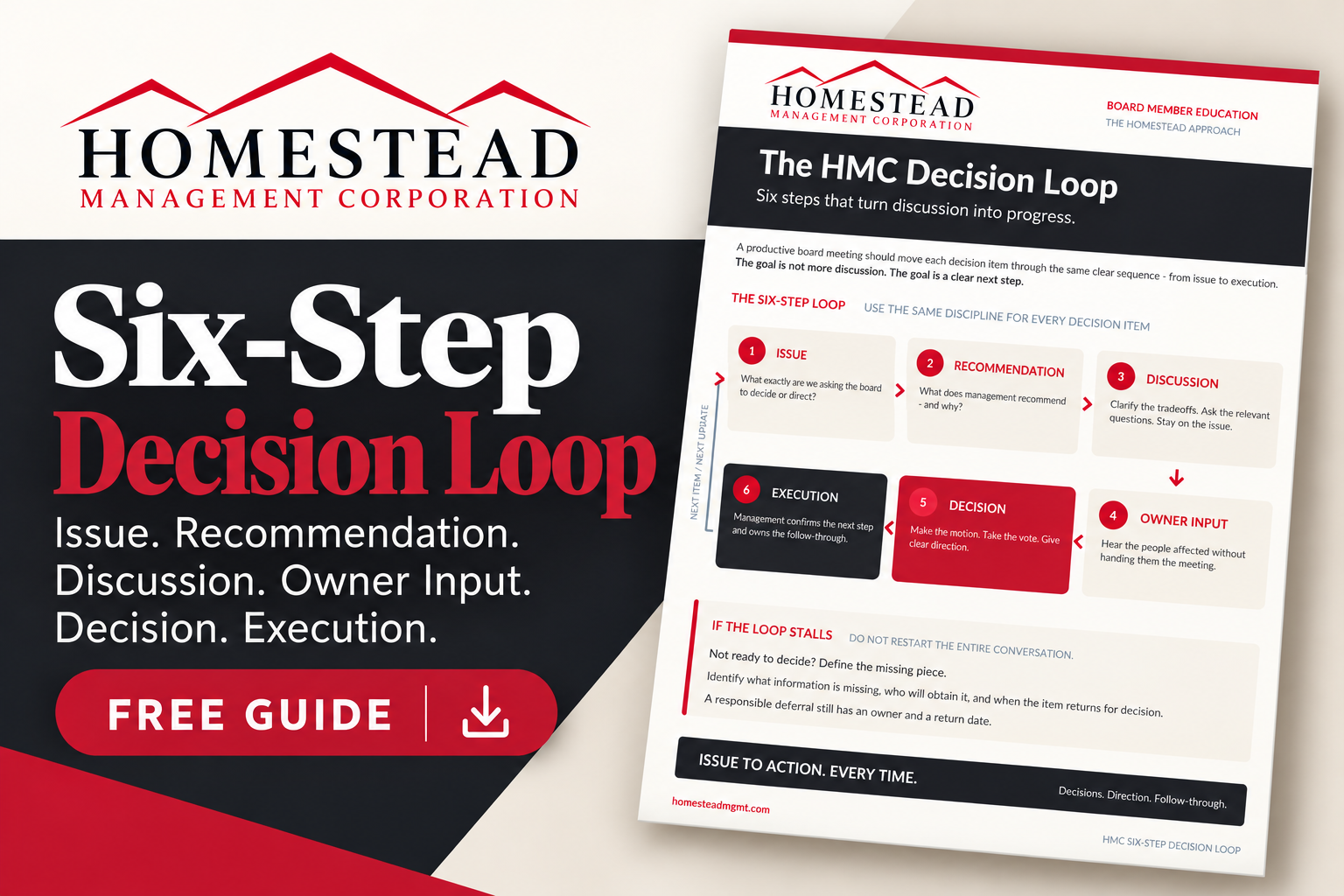
1. What is the issue? Management explains the problem or opportunity.
2. What does management recommend? Do not simply dump three proposals into the board packet. Explain the professional recommendation and why.
3. What does the board need clarified? Directors ask questions and discuss the relevant tradeoffs.
4. What owner input needs to be heard? Provide the appropriate, structured opportunity for homeowner comment.
5. What is the decision? Make the motion. Take the vote.
6. Who owns what happens next? Management confirms the follow-through.
That loop may take four minutes on one item and forty minutes on another. The principle is the same.
Issue. Recommendation. Discussion. Input. Decision. Execution.
The goal is not to have the shortest meeting possible. Some communities have substantial business. Some issues deserve extended discussion. Sometimes disagreement is important. The goal is to make the time useful. At the end of the meeting, the board should be able to look back and see movement:
A project approved.
A contract declined.
A policy clarified.
A professional engaged.
A budget direction established.
A homeowner concern heard.
A missing question assigned.
A difficult decision finally made.
That is a board meeting that works. Not because everybody agreed. Not because nobody got frustrated. Not because every director demonstrated how much they knew. Because the community walked out with decisions, direction, and a path forward.
No. Some items are informational, and others may only require board direction. But a matter requiring a future decision should not repeatedly leave the meeting with no defined next step.
Identify precisely what is missing, assign management or the appropriate professional to obtain it, and establish when the item returns. Responsible investigation is different from open-ended postponement.
Applicable law and governing documents control the formal requirements. Operationally, homeowner comment works best when the board provides a predictable opportunity to be heard without turning the meeting into an unrestricted group discussion. Colorado and Arizona both provide statutory owner-speaking rights in association board meetings, with specific requirements that should be followed. Colorado General Assembly
Only when the matter fits a legally permitted closed-session purpose and the association follows the applicable process. A controversial or uncomfortable subject does not automatically belong behind closed doors. Colorado and Arizona both identify limited categories for closed discussion. Colorado General Assembly
In Homestead's full-service model, the Community Manager should organize the agenda and supporting material based on community business and matters raised by the board throughout the month. The board retains its governing authority, but management should do the preparation necessary to make meeting time productive.
This article provides general governance and management education, not legal advice. Meeting requirements vary by jurisdiction, governing documents, association circumstances, and the specific matter being considered. Associations should consult qualified legal counsel when legal interpretation is required.