BIG NEWS: Homestead is a 2026 BBB Torch Awards for Ethics Finalist.
READ THE STORY →

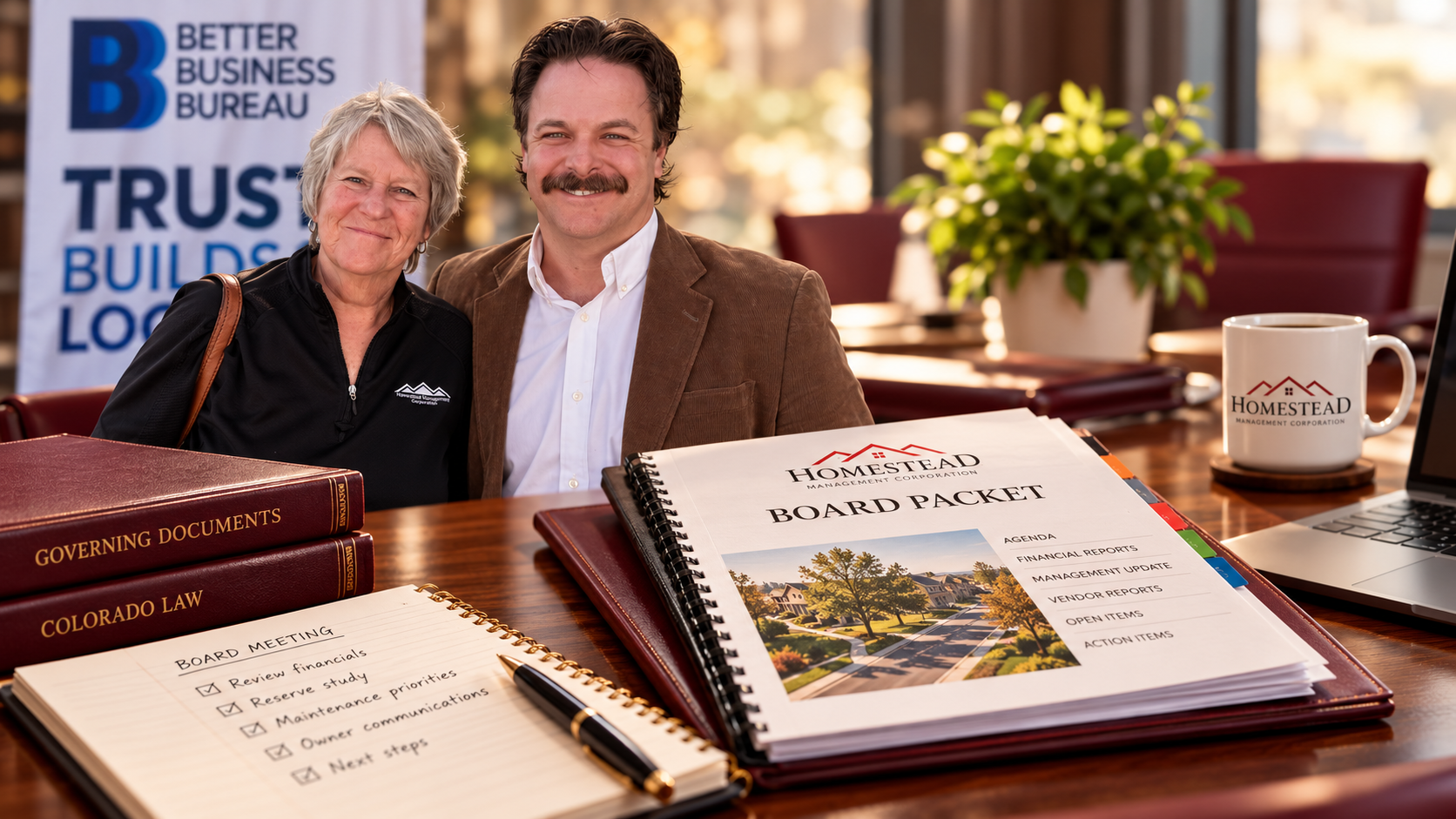
An HOA board member's fiduciary responsibility means making informed, good-faith decisions in the interests of the association rather than simply following personal preferences or avoiding unpopular choices. That requires understanding governing documents, asking questions, considering professional advice, and weighing consequences for the entire community. Good intentions matter, but responsible decisions also require preparation, sound judgment, and a willingness to do what's right even when it's difficult.
Doing the right thing isn't always good for business. But it's always the right way to do business.
My parents built Homestead on a principle that has never changed: We have an obligation to tell our boards what they need to hear, not simply what they want to hear. Sometimes that means recommending an unpopular assessment increase. Sometimes it means challenging a board's decision. And sometimes it means being willing to lose a management contract rather than participate in something we believe is wrong.
But ethical responsibility works both ways. Board members don't have to know everything. Neither do managers. What matters is the willingness to ask questions, listen to professional advice, acknowledge what you don't know, and make decisions in good faith. I've worked with extraordinary board members who never stopped asking questions, despite decades of experience and impressive professional backgrounds. Their humility wasn't a weakness. It was one of their greatest strengths.
Fiduciary responsibility isn't about being right all the time. It's about being committed to doing what's right every time.
That's the standard my parents established in 1978. It's the standard I expect from our management team today, and it's the standard I encourage every HOA board member to embrace. Because when we do what's best for the community, we're doing what's best for Homestead.
-Will Such, CEO
A conversation with Julie Such and William Such
Homestead Management Corporation | Family-Owned Since 1978
On October 29, 2026, we had the privilege of attending the Better Business Bureau Torch Awards for Ethics, where Homestead Management Corporation was recognized as a finalist. We didn't take home the award, but being recognized for something that has guided our family business since 1978 was meaningful in its own right.
On the drive home, we found ourselves discussing a subject that seemed particularly appropriate for the occasion: What does it really mean to fulfill your fiduciary responsibility as a homeowners association board member?
It's a phrase that gets thrown around constantly in HOA management. It's also a phrase that can make an otherwise perfectly capable volunteer feel as though they've accidentally signed up to become a lawyer. But fiduciary responsibility doesn't have to be complicated. In fact, some of the most important lessons about it have very little to do with legal terminology. They have to do with preparation, sound judgment, humility, courage, and doing what's right when doing what's right isn't particularly popular. After nearly five decades in this business, we've learned that those qualities matter far more than the ability to recite a statute.
Julie Such, Co-Founder
When Dwight and I started Homestead in 1978, one of our earliest responsibilities was simply helping people understand what a homeowners association was. It was a relatively unfamiliar concept to many homeowners, and even today, a surprising number of people purchase a home in an HOA without fully understanding what they've agreed to. They may not read their governing documents until they receive a violation letter. They may assume their monthly assessments are going directly into the management company's pocket. They may have very little understanding of what the association is responsible for and what remains their own responsibility.
I don't particularly fault homeowners for that. Buying a home is probably the largest financial commitment most families will ever make. It's where they raise their children. It's deeply personal. But there's another reality that board members must understand. A homeowners association is a business. It may be organized as a nonprofit corporation, but it still requires responsible business decisions. There are financial obligations, contracts, maintenance responsibilities, governing documents, and decisions that affect an entire community. The board doesn't get to simply invent its own understanding of how that business should operate.
The association's governing documents established responsibilities and restrictions long before the current board members took office. Those documents, together with applicable laws, provide the framework within which the board must operate. Our job as professional managers has always been to help boards understand that framework. Sometimes that means explaining financial reports. Sometimes it means helping directors understand why a decision they're considering may conflict with their governing documents. And sometimes it means explaining to a frustrated homeowner why the association has a responsibility to do something the homeowner doesn't particularly appreciate.
One thing we've learned is that understanding often changes the conversation. When people understand the reasoning behind an association's responsibilities, they tend to become considerably more comfortable with them. Education has always been an important part of ethical management.
Julie Such
If I could give one piece of advice to someone who has just been elected to an HOA board for the first time, it would be this: Give yourself permission to learn before you try to lead. You don't automatically understand the operation of a homeowners association simply because you've been elected to its board, and there's absolutely nothing wrong with that.
In fact, some of the best board members I've encountered over the years were the ones who recognized how much they still needed to learn. They attended their first few meetings with an open mind. They observed how the board operated, listened to the manager, and reviewed the governing documents. Then something encouraging would happen. At a subsequent meeting, that board member would say something like, "I went back and looked at that section of our covenants, and now I understand why we handle it that way." That's a wonderful quality in a board member.
Certainly, they still have responsibilities from their very first meeting. They're voting on decisions that matter. But they don't need to arrive knowing everything. Take time to understand the role you've accepted. Understand the board's authority and its limitations. Understand the responsibilities the association has to its homeowners. Understand that a disgruntled homeowner doesn't necessarily mean the board is doing something wrong. And perhaps most importantly, understand that you have an opportunity to become a very good board member without experiencing a baptism by fire.
The willingness to learn is one of the most important characteristics a director can bring to the table.
William Such, Owner and CEO
I couldn't agree more with that assessment. In fact, one of the best examples I can think of involves a longtime board member who served as a police chief. Here was someone whose professional career required leadership, difficult decisions, sound judgment, and an extraordinary degree of personal responsibility. He certainly wasn't intimidated by making decisions, and yet, throughout his many years of board service, he consistently asked our management team questions. Not because he lacked confidence or couldn't make decisions independently, but because he recognized something important: Being an accomplished professional in one field doesn't automatically make you an expert in another.
He understood that HOA management was our profession. He wasn't interested in proving that he knew more than the manager. He was interested in making the best decisions possible for his community. That's the kind of professional humility that makes an exceptional board member. When an association has a competent, trusted management company, its manager may well be the most knowledgeable person in the room about the day-to-day operation of that homeowners association.
That doesn't mean the manager is always right, that the board should blindly follow every recommendation, or that board members should surrender their decision-making authority. It means there should be a healthy, professional exchange of information. The manager should be comfortable explaining a recommendation, the board should be comfortable asking questions, and both should recognize that they're working toward the same objective. Good-faith questions should travel in both directions. A manager who cannot tolerate questions isn't serving the board particularly well, and a board member who refuses to ask questions because they believe they already know everything isn't serving the community particularly well, either.
Julie Such
One thing I think new board members should understand is that they're going to make some people unhappy. That's practically unavoidable. When decisions affect people's homes, money, and personal preferences, emotions can run high. But there's a right way and a wrong way to handle those situations.
We've always tried to help boards prepare for potentially difficult meetings. Sometimes that advice is as simple as reminding directors not to get drawn into an ugly exchange with a homeowner. Don't start swearing. Don't become argumentative. Don't turn a disagreement into something personal. You have to maintain a level of professionalism, and in this business, I think it's an especially important kind of professionalism because you're dealing with something that is intensely personal to the people involved.
A homeowner might be furious about a particular decision, but that doesn't mean the board has to match their anger. In fact, once a board member allows a discussion to deteriorate into a personal confrontation, they've often surrendered much of the credibility and authority that came with their position. You can explain an unpopular decision without being disrespectful, maintain your position without being combative, and disagree with a homeowner while still treating that person with dignity. Those things aren't mutually exclusive.
William Such
This is where fiduciary responsibility becomes especially important. Consider a board that knows its community needs an assessment increase. Maybe the buildings are aging, the siding is approaching the end of its useful life, or reserve funding has fallen behind. The board knows these things, but the directors also know that raising assessments will make homeowners unhappy. So they postpone the decision, and then they postpone it again. Eventually, they're hoping for a hailstorm because an insurance claim seems preferable to telling homeowners that the community needs to pay for its own maintenance. That's not responsible long-term planning. It's avoiding an uncomfortable decision.
Now, circumstances absolutely matter. Boards should consider affordability, financial alternatives, timing, and the real impact assessments have on homeowners. Some homeowners genuinely cannot afford an increase, and that deserves thoughtful consideration. But the board also has to consider every other homeowner in the community. Those homeowners have an interest in properly maintained buildings, protected property values, and an association capable of meeting its obligations.
The same principle applies to rules enforcement. Nobody particularly enjoys sending a violation letter, but allowing one owner's preferences to override the community's legitimately adopted standards can create consequences for everyone else. A board's responsibility isn't to eliminate every uncomfortable consequence for every individual homeowner. It's to make informed, fair decisions in the interests of the association as a whole. Sometimes those decisions will be unpopular. That doesn't necessarily make them wrong. In fact, sometimes an unpopular decision is exactly what responsible stewardship requires.
William Such
When someone asks me to define fiduciary responsibility, my mind doesn't immediately go to legal terminology. Certainly, the law matters. Governing documents matter. Boards have obligations they cannot disregard simply because they feel differently. Colorado law, for example, establishes standards involving good faith, reasonable care, and the association's interests. The precise legal obligations and liability protections depend on the circumstances.
But I believe truly ethical decision-making requires something beyond asking, "Can we legally get away with this?" That's a pretty low standard to set for yourself. The more important questions are whether you're being fair, whether you've made a genuine effort to understand the situation, and whether you're doing what you reasonably believe is right for the community.
If your entire decision-making process is focused on finding the absolute minimum you're legally required to do, you may be missing something important. Legal compliance establishes necessary boundaries. Ethical leadership determines how responsibly you operate within them. And when a board starts rationalizing a questionable decision simply because it believes nobody can legally stop it, that's a good indication that it needs to reconsider its approach.
Julie Such
When Dwight and I started Homestead, we never sat down and developed some elaborate philosophy about ethics. We simply tried to do what we believed was right. And Dwight has always been particularly clear-sighted about those situations. When an ethical question arises, he's remarkably difficult to move away from what he believes is the proper course. If something needs to be said to a board, he says it. That doesn't mean he's deliberately confrontational. It means he understands that avoiding an uncomfortable conversation doesn't make the underlying problem disappear.
Of course, there's a risk involved. Sometimes a board doesn't want to hear what its management company is telling it. Sometimes the disagreement becomes significant enough that the association may decide to terminate its management contract. We understood that possibility from the very beginning. We never liked losing customers, and we still don't. But there have always been circumstances where continuing a business relationship would require us to accept conduct or decisions that we simply couldn't support. At that point, we have to be willing to lose the contract.
That's not a decision any business owner takes lightly. But if your ethical principles disappear the moment they threaten your revenue, they weren't particularly meaningful principles to begin with.
William Such
And that hasn't changed. Every time. Everywhere. We don't get to decide that ethics matter only when they're convenient. We don't get to suspend those principles because a particular association represents significant revenue, and we don't get to tell a board what it wants to hear simply because we're afraid of losing its business.
Our responsibility is to provide sound professional guidance. The board remains responsible for making its decisions, but we have to be able to look ourselves in the mirror afterward and know we provided the guidance we genuinely believed was appropriate.
Julie and William Such
After decades of working with homeowners associations, we believe some of the best boards share a remarkably simple characteristic: They're willing to learn. They understand that board membership is a responsibility, not a declaration of expertise. They ask questions, read their governing documents, listen to professional guidance, and consider the consequences of their decisions. They don't confuse a homeowner's anger with evidence that the board has done something wrong, and they don't confuse their own authority with an obligation to have every answer.
Most importantly, they understand that responsible leadership requires both judgment and character. Professional management can provide financial information, institutional knowledge, recommendations, and guidance. It can help a board understand its obligations and consider the consequences of different choices, but ultimately, the board must exercise its own judgment.
That relationship works best when both sides respect the responsibilities of the other. A manager should never be offended by a thoughtful question, and a board member should never be embarrassed to ask one. Neither should lose sight of the reason they're sitting at the table in the first place.
We began this conversation on the drive home from an awards ceremony recognizing business ethics. It was an honor to be a finalist, but the more important recognition of ethical conduct doesn't happen at an awards ceremony. It happens in ordinary moments.
It happens when a new board member admits they don't understand something and asks for an explanation. It happens when a director votes for necessary maintenance despite knowing homeowners will be unhappy about the cost. It happens when a board calmly enforces a legitimate community standard rather than being intimidated by an angry response. It happens when a manager tells a board something it doesn't want to hear, and it happens when a management company is willing to lose a customer rather than compromise its principles.
Those moments aren't always glamorous. They rarely earn applause, but they're the moments that define responsible leadership. After nearly five decades of serving homeowners associations, our advice to board members is straightforward:
Learn before you assume. Ask before you decide. Listen before you react. And when the right decision is difficult, have the courage to make it anyway.
That's what responsible stewardship looks like. And that's how you build communities, professional relationships, and businesses that stand the test of time.